

Currently Empty: ₹0.00
A Data Structure is a way of organizing and storing a collection of data elements in a structured manner so that it can be accessed and modified efficiently.
For example:
When there is only one student, the data such as name, age, and roll number can be stored easily. For example, a student named Pawan has Name = “Pawan”, Age = 17, and Class = 4. Even simple storage methods are enough for managing such small data.
However, when there are hundreds or thousands of students, manual or simple storage methods become inefficient. In such cases, Data Structures are required to organize the records properly. They help in:
- Fast searching of student records
- Easy insertion of new data
- Easy deletion and updating of records
- Efficient use of memory
Therefore, Data Structures like Arrays, Lists, or Files are useful for both small and large amounts of data, but they are most important when handling large data sets.
What is Data Structure?
In simple words, a Data Structure is a structured way of storing data in an ordered and organized form so that operations such as searching, insertion, deletion, and updating can be done efficiently. A well-designed data structure increases efficiency and reduces complexity.
You can also remember it as: Data Structures allow us to store information in such a way that it can be created, viewed, processed, and managed easily.
Types of Data Structures
1. Arrays
An array stores similar types of data in continuous memory locations. Because elements are stored together, the position of any element can be calculated using the base address. Each element has an index starting from 0.
Example:
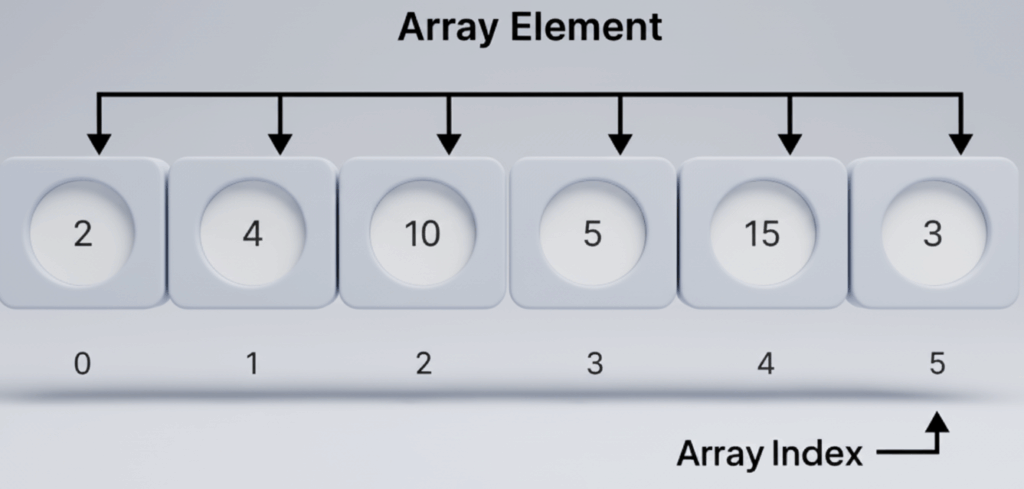
Consider an array [2, 4, 10, 5, 15, 3]. Here, 2 is at index 0, 4 at index 1, and so on. Accessing index 2 returns 10.
2. Stacks
A Stack is a linear, recursive data structure that follows the LIFO (Last In, First Out) or FILO (First In, Last Out) principle. The last pushed element is removed first. It supports two main operations: push (insert) and pop (remove).
Example:
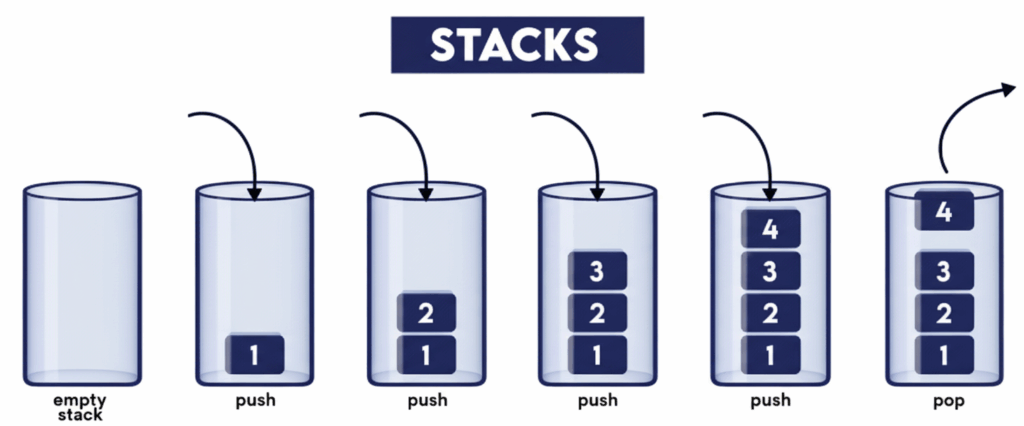
Initially the stack is empty. After pushing 1, 2, 3, 4, the top element becomes 4. When we perform a pop, 4 is removed first.
3. Queues
A Queue is a linear data structure that follows the FIFO (First In, First Out) principle. New elements are added at the rear and removed from the front, just like a line of people waiting for their turn.
Example:
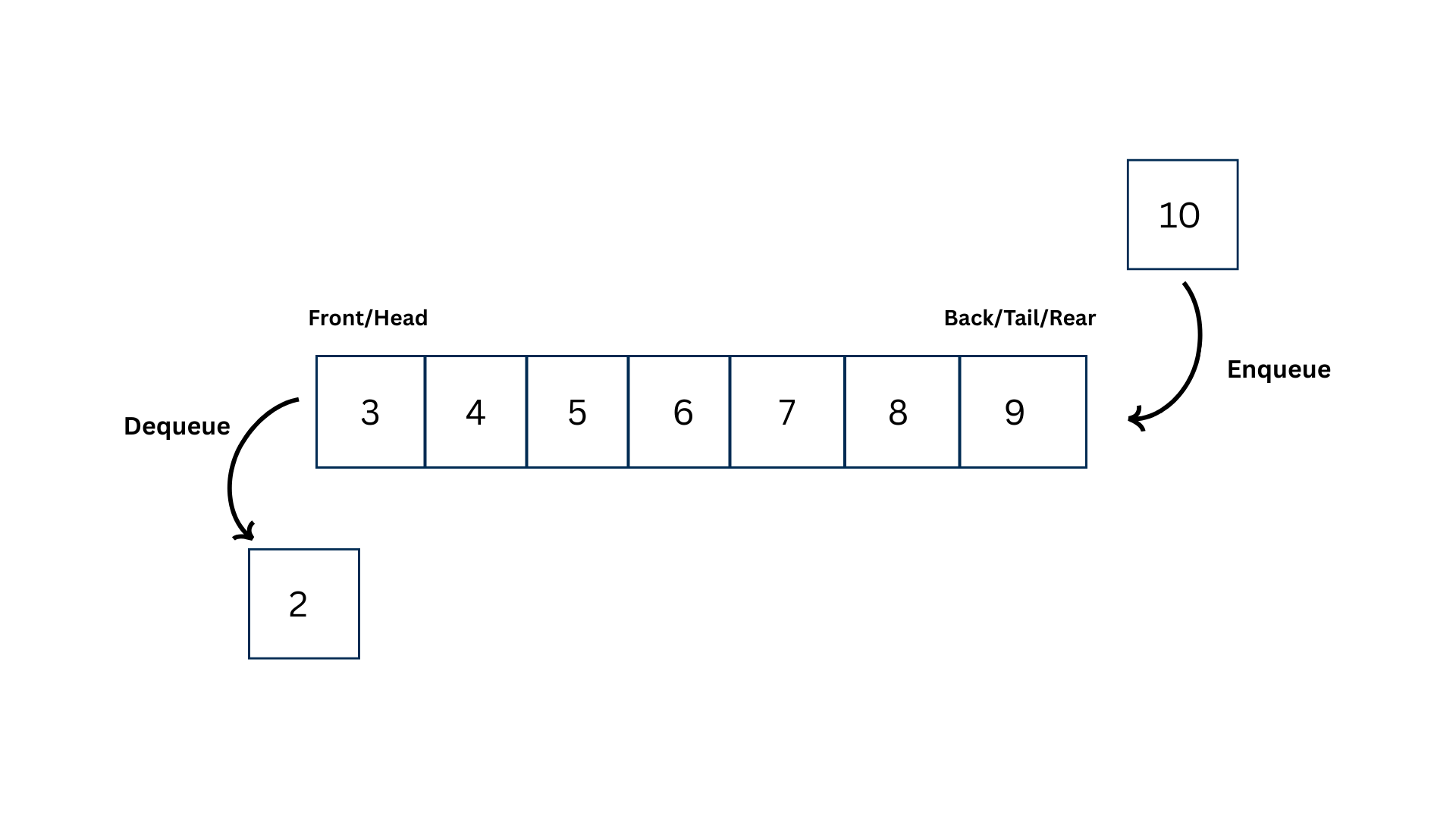
The queue contains elements 2, 3, 4, 5, 6, 7, 8, 9. A new element 10 is added at the rear, and the element 2 is removed from the front.
4. Linked Lists
A linked list stores elements in non-contiguous memory locations. Each node contains two fields: data and a reference (link) to the next node. The last node points to NULL, indicating the end.
Example:
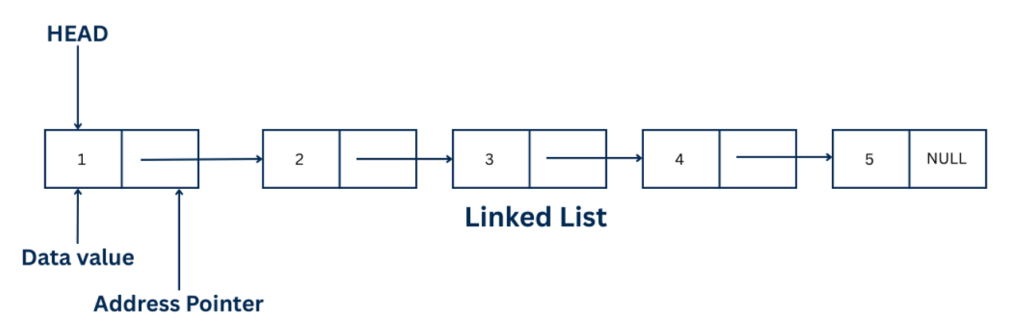
The first node stores 1 and its next pointer refers to the next node storing 2, and so on. The last node points to NULL. The first node is accessed through Head.
5. Trees
A Tree is a non-linear, hierarchical data structure. It has a single root node from which child nodes branch out. Each node has one parent except the root. Nodes with no children are called leaf nodes.